
General Conference weekend April 4 and 5, 2008!
We couldn't be in the Conference Center with thousands of members, but it was a power boost for us in Mérida as it used to be in Colonia Dublán. We thought of our dear family in Wildomar, Maple Valley, Springfield, Herriman, Willcox, Sandy, and Issaquah and hoped that they were able to listen to the conference sessions and receive inspiration for their lives. Whether we listen in our PJ's, go to a chapel for the satellite transmission, watch over the Internet, or try to listen with a house full of children of all ages, as members of the Church our attention is focused twice a year on counsel from living prophets.
We marveled at the way the Church uses technology to bring the Gospel to each individual and appreciated our new laptop with its capability to bring the speakers up close and personal as we watched over the Internet.

As we contemplate how to use the messages in our lives, with our daily challenge to come unto Christ, because of different needs and situations in our lives, some talks have more meaning for us than others. I know that major addresses on the Savior's Atonement, affliction, following the prophets and service will be helpful for us. Shorter sermons by members of the Quorum of the 70 were also very good for thought, and it is interesting to hear their different accents and think how they have been prepared for this call.
I especially want to read and reread Elder Christofferson's talk on the power that we obtain
 through making and keeping covenants. It helps explain why Jesus'apostles were able to fulfill the charge He gave them in Matthew 28:19-20 - "Go ye therefore, and teach all nations, baptizing them in the name of the Father, and of the Son, and of the Holy Ghost: Teaching them to observe all things whatsoever I have commanded you: and, lo, I am with you alway, even unto the end of the world. "
The ideas presented by Elder Quentin L. Cook about how members of the Church appear to others caught my attention.
 When he mentioned Charles Dickens' impressions of the Mormons on board the ship sailing from London , England, I remembered a family history story that my mother had told. That night after conference was over I was transcribing some letters of my mother and saw where she had written in 1967:
Of course I wanted to learn more about that encounter, so began researching.
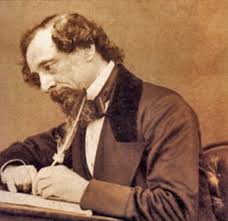 Charles Dickens: The Uncommercial Traveller
22. CHAPTER XXII--BOUND FOR THE GREAT SALT LAKE
Behold me on my way to an Emigrant Ship, on a hot morning early in June. My road lies through that part of London generally known to the initiated as 'Down by the Docks.' Down by the Docks, is home to a good many people--to too many, if I may judge from the overflow of local population in the streets-.... http://www.literaturepage.com/read/dickens-the-uncommercial-traveller-216.html"I . . . had come aboard this emigrant ship to see what eight hundred Latter-day Saints were like," he wrote. "Indeed, I think it would be difficult to find eight hundred people together anywhere else, and find so much beauty and so much strength and capacity for work among them" (The Uncommercial Traveler [1863], 446). Fully expecting to "bear testimony against" the Latter-day Saints, Dickens changed his opinion after observing the passengers: "To my great astonishment," he said, "they did not deserve it" (449).In Dickens's book, The Uncommercial Traveler, he describes the scene he beheld with wonder:"Nobody is in an ill temper, nobody is the worse for drink, nobody swears an oath or uses a coarse word, nobody appears depressed, nobody is weeping, and down upon the deck, in every corner where it is possible to find a few spare feet to kneel, crouch, or lie in, people in every unsuitable attitude for writing, are writing letters" (445).http://www.lds.org/gospellibrary/pioneer/01_Convert_Immigrants.html
Another article that gave much more information was
“The Voyage of the Amazon: A Close View of One Immigrant Company,”Richard L. Jensen and Gordon Irving, Ensign, Mar 1980, 16 on http://www.lds.org/
In June of 1863 the Amazon, a passenger ship with 891 Latter-day Saints aboard, set sail from London. Just before the voyage, many Londoners—government officials and clergymen included—came for a firsthand look at the Mormons and their traveling arrangements. Among the visitors was author Charles Dickens, who spent several hours on board the ship questioning British Mission President George Q. Cannon and quietly observing the Saints.
A month later Dickens published an account of his visit to the Mormon emigrant ship. He pointed out that these were primarily working-class people, including craftsmen in many trades. Though he remained skeptical about what the Mormons would find when they reached Utah, Dickens was impressed by their thoroughgoing organization, their calmness, and their quiet self-respect:
“I went on board their ship,” he said, “to bear testimony against them if they deserved it, as I fully believed they would; to my great astonishment they did not deserve it; and my predispositions and tendencies must not affect me as an honest witness. I went over the Amazon’s side feeling it impossible to deny that, so far, some remarkable influence had produced a remarkable result, which better known influences have often missed.” Of the people themselves Dickens wrote that had he not known they were Mormons, he would have described them as, “in their degree, the pick and flower of England.” 1...
...of prime importance in determining when a family would emigrate was the matter of finances. In spite of great faith, many would-be emigrants found it difficult to save enough money to pay for their passage and other expenses. Charles and Eliza West joined the Church in 1849 and began in 1853 to put money into the individual emigrating accounts kept by local Church leaders. But the expenses of a growing family made saving difficult. “We had children faster than we could get means for our emigration,” Charles told a visiting missionary in 1862. 5 That year the Wests arranged for an emigrating couple from their branch to take two of the West daughters with them. The family then had extra incentive to save so they could join their daughters the next year.
The Wests were apparently typical. Half the married adults aboard the Amazon had been Latter-day Saints for thirteen years or more. Even those with a larger income found it difficult to save for emigration. But single adults, without the expense of a family, generally emigrated three to four years sooner after baptism than married adults. Though some of the Amazon passengers were recent converts, eighty-five percent of the adults had been members more than five years before they emigrated....
5. Charles Henry John West Journal, 1833–1906, photocopy of typescript in the possession of the authors, p. 4.
It definitely makes Conference more worthwhile when something strikes a chord and causes further study. I'm also very grateful for ancestors who were faithful and brave because of their testimony. This shows me the power obtained individually and as a Church from making and keeping covenants with the Lord.
No comments:
Post a Comment